上一章学了 x86-64 汇编形态。这一章学C++ this 指针:C 里写 struct 加函数,C++ 写 class 加方法,编译器翻译成什么。
前 12 章学的都是 C 语言的汇编形态。从这一章开始进入 C++ 领域。C++ 的类、方法、继承、多态在汇编层面并不神秘,核心就一件事:this 指针。obj.method(a, b) 在汇编里是 lea ecx, [obj]; push b; push a; call method,ECX 存对象地址,方法内部用 [ecx+offset] 访问成员。学会识别 this 指针,你就从”看得懂 C”跨入”看得懂 C++”。
和前几章一样,编译 Debug x86,用 x64dbg 断到函数对照。汇编只保留 this 指针和成员访问相关的核心指令,过滤掉 Debug 噪音。
thiscall:ECX 传 this
C 语言的 cdecl 调用约定把所有参数压栈。C++ 的成员方法多了一个隐含参数:this 指针。MSVC 用 thiscall 约定,this 走 ECX 寄存器,其余参数走栈:
class Player {
public:
    int hp;
    int mp;
    int x;
    int y;

    void set_pos(int nx, int ny) {
        x = nx;
        y = ny;
    }
};
set_pos 有两个显式参数(nx、ny)和一个隐含参数(this)。调用方:
Player p;
p.set_pos(10, 20);
; 调用方(main 里)
push 0x14 ; ny = 20(第二参数,逆序 push)
push 0x0A ; nx = 10(第一参数)
lea ecx, [ebp-24] ; ecx = &p(this 指针)
call set_poscdecl 是 push arg2 / push arg1 / call func。thiscall 多一步 lea ecx, [obj] 把对象地址放进 ECX。参数压栈顺序和 cdecl 一样(从右到左)。
- cdecl:所有参数走栈,调用方清栈(
add esp, N) - thiscall:
this走 ECX,其余参数走栈,被调方清栈(ret N)
thiscall 和 stdcall 类似:被调方用 ret N 清理栈上的参数。区别只是 thiscall 多了 ECX 传 this。逆向识别:调用前有 lea ecx, [对象地址],函数末尾 ret N(N = 栈上参数总字节数)。
方法内部:[this+offset] 访问成员
被调方怎么用 this 访问成员?看 set_pos 的汇编:
set_pos:
    push ebp
    mov  ebp, esp
    ...
    push ecx               ; 保存 this(占用 [ebp-8] 槽位)
    ...
    pop  ecx               ; 恢复(Debug 噪音中的 rep stos 用了 ecx)
    mov  dword ptr [ebp-8], ecx    ; this 存到本地变量
    ...
    mov  eax, dword ptr [ebp-8]    ; eax = this
    mov  ecx, dword ptr [ebp+8]    ; ecx = nx(第一栈参数)
    mov  dword ptr [eax+8], ecx    ; this->x = nx(偏移 +8)
    mov  eax, dword ptr [ebp-8]    ; eax = this
    mov  ecx, dword ptr [ebp+0C]   ; ecx = ny(第二栈参数)
    mov  dword ptr [eax+0C], ecx   ; this->y = ny(偏移 +0C)
    ...
    ret  8                  ; 清栈:2 个 int = 8 字节
this 从 ECX 传入,函数开头保存到 [ebp-8](局部变量)。每次访问成员时先 mov eax, [ebp-8] 取出 this,再用 [eax+offset] 访问成员。
成员偏移按声明顺序排列,和 C 结构体一样:
| 成员 | 偏移 | 值 |
|---|---|---|
| hp | +0 | int |
| mp | +4 | int |
| x | +8 | int |
| y | +0xC | int |
[eax+8] 是 this->x,[eax+0C] 是 this->y。这和 c-asm-10 学的结构体成员访问完全一样,只是基址从 ECX(this)来。
Debug 模式把 this 存到 [ebp-8] 而不是直接用 ECX,是因为 Debug 模式需要随时能在内存里查看 this 的值,且 ECX 可能被其他指令借用。Release 模式会优化掉这步,直接用 ECX。逆向 Debug 时,函数开头 push ecx + mov [ebp-8], ecx 是识别 this 的特征。
读成员
int get_hp(void) {
    return hp;
}get_hp:
push ebp
mov ebp, esp
...
mov eax, dword ptr [ebp-8] ; eax = this
mov eax, dword ptr [eax] ; eax = this->hp(偏移 +0)
...
ret ; 0 个栈参数,ret 不带数字get_hp 没有显式参数,this 是唯一参数。mov eax, [eax] 读取 this->hp(偏移 0)。ret 不带数字,因为没有栈参数需要清理。
写成员:读-改-写
void damage(int amount) {
    hp = hp - amount;
}damage:
push ebp
mov ebp, esp
...
mov eax, dword ptr [ebp-8] ; eax = this
mov ecx, dword ptr [eax] ; ecx = this->hp
sub ecx, dword ptr [ebp+8] ; ecx = hp - amount
mov edx, dword ptr [ebp-8] ; edx = this
mov dword ptr [edx], ecx ; this->hp = result(偏移 +0)
...
ret 4 ; 清栈:1 个 int = 4 字节damage 有 1 个显式参数(amount),在 [ebp+8]。先读 this->hp 到 ECX,sub 减去 amount,再写回 this->hp。ret 4 清理 1 个 int 参数。
引用参数:就是指针
C++ 的引用(int&)在汇编层面和指针(int*)完全一样,都是传地址,函数内部解引用:
void add_by_ref(int& ref) {
    ref = ref + 10;
}

void add_by_ptr(int* ptr) {
    *ptr = *ptr + 10;
}
; add_by_ref 和 add_by_ptr 的函数体完全相同:
mov eax, dword ptr [ebp+8] ; 取地址
mov ecx, dword ptr [eax] ; 解引用读
add ecx, 0x0A ; 加 10
mov edx, dword ptr [ebp+8] ; 取地址
mov dword ptr [edx], ecx ; 解引用写调用方也一样:add_by_ref(val) 和 add_by_ptr(&val) 都生成 lea eax, [ebp-2Ch]; push eax。引用和指针在汇编上完全无法区分,唯一区别在 dumpbin 的函数签名标注(int & vs int *)。
引用是 C++ 的语法糖,汇编层面就是指针。void f(int& r) 和 void f(int* p) 生成完全一样的代码。逆向时看到 [ebp+8] 存的是地址,函数内部 mov [eax] 解引用读写,无法判断原参数是引用还是指针。通常按指针处理。
构造函数和析构函数
C 里你写 struct Player p;,p 的成员是未初始化的垃圾值,得自己手动赋值。C++ 加了两个特殊函数:
- 构造函数:程序员写函数体(决定初始化成什么值),编译器在对象创建时自动插入调用
- 析构函数:程序员写函数体(决定清理什么),编译器在对象销毁时自动插入调用
用户不需要手动 call 它们,编译器会在合适的位置自动插入。
class Player {
public:
    int hp, mp, x, y;
    Player() {            // 构造函数
        hp = 100; mp = 50; x = 0; y = 0;
    }
    ~Player() {           // 析构函数
        hp = 0;
    }
    void set_pos(int nx, int ny) { x = nx; y = ny; }
};

void func(void) {
    Player p;             // 编译器自动 call Player::Player()
    p.set_pos(10, 20);    // 你手动调用的方法
    // 函数返回前,编译器自动 call Player::~Player()
}
用户只写了 3 行代码,但编译器翻译出来的汇编里有 4 个 call:构造、set_pos、damage、析构。构造和析构的函数体是程序员写的,但调用是编译器自动插入的。
构造函数的汇编
; 调用方(main 里)
lea  ecx, [ebp-24]           ; ecx = &p(this 指针)
call Player::Player          ; 编译器自动插入的构造调用
; --- 构造函数返回后,对象已初始化 ---
push 0x14
push 0x0A
lea  ecx, [ebp-24]           ; 重新设 this
call set_pos                 ; 用户写的方法调用
Player p; 这行代码,用户没写 call,但汇编里出现了 call Player::Player。这就是编译器自动插入的构造函数调用。构造函数内部初始化所有成员:
Player::Player:
    push ebp
    mov  ebp, esp
    ...
    push ecx                    ; 保存 this
    ...
    mov  dword ptr [ebp-8], ecx ; this 存到本地变量
    ...
    mov  eax, dword ptr [ebp-8] ; eax = this
    mov  dword ptr [eax], 0x64       ; this->hp = 100
    mov  eax, dword ptr [ebp-8]
    mov  dword ptr [eax+4], 0x32     ; this->mp = 50
    mov  eax, dword ptr [ebp-8]
    mov  dword ptr [eax+8], 0        ; this->x = 0
    mov  eax, dword ptr [ebp-8]
    mov  dword ptr [eax+0C], 0       ; this->y = 0
    ...
    ret                         ; 0 个栈参数
构造函数的特征:
- 没有返回值,不像普通函数末尾
mov eax, <值> - 对每个成员做赋值,用
[this+offset] = 常量模式 ret不带数字(无显式参数)
一个 thiscall 函数,对对象的每个成员逐个赋值(mov dword ptr [eax+offset], 常量),且没有返回值,很可能是构造函数。逆向时看到 lea ecx, [obj]; call func 在对象刚创建后执行,且函数内部全是成员初始化,就是构造函数。
MSVC 的名称修饰(name mangling)里,构造函数以 ??0 开头,析构函数以 ??1 开头。例如 ??0Player@@QAE@XZ 是 Player::Player,??1Player@@QAE@XZ 是 Player::~Player。??2 是 operator new,??3 是 operator delete。逆向时在符号表里看到这些前缀就能快速判断。
析构函数的汇编
析构函数和构造函数相反:构造函数在对象创建时自动调用,析构函数在对象销毁时自动调用。局部对象在所在函数返回前析构。
用户没写 call ~Player(),但编译器在函数末尾(ret 之前)自动插入:
; 调用方(main 末尾,ret 之前)
lea  ecx, [ebp-24]           ; ecx = &p
call Player::~Player         ; 编译器自动插入的析构调用
析构函数内部:
Player::~Player:
    push ebp
    mov  ebp, esp
    ...
    mov  dword ptr [ebp-8], ecx ; this 存到本地变量
    ...
    mov  eax, dword ptr [ebp-8] ; eax = this
    mov  dword ptr [eax], 0    ; this->hp = 0
    ...
    ret
这个析构函数只是把 hp 清零。和构造函数很像,也是 thiscall、无返回值、ret 不带数字。区别是析构函数在函数末尾调用(对象生命周期结束),且通常做清理(释放资源、清零成员)。
局部对象的构造函数在声明处调用,析构函数在所在函数返回前调用。逆向时看到函数末尾(ret 之前)有一串 lea ecx, [对象地址]; call 析构函数,就是局部对象在析构。main 函数里尤其明显:开头构造、结尾析构。
堆对象:new 和 delete
前面的 Player p 是栈上对象,编译器自动插入构造和析构。堆对象用 new 分配、delete 释放,汇编形态完全不同:
Player* p = new Player();   // 堆对象
printf("hp=%d\n", p->hp);
delete p;
; new Player()
push 0x10 ; sizeof(Player)=16
call ??2@YAPAXI@Z ; operator new(16) -> eax = 堆地址
add esp, 4 ; cdecl 清栈
mov [ebp-0EC], eax ; 暂存堆地址
cmp dword ptr [ebp-0EC], 0 ; 检查是否分配成功
je skip_ctor ; nullptr 则跳过构造
mov ecx, dword ptr [ebp-0EC]; this = 堆地址
call ??0Player@@QAE@XZ ; Player::Player 构造
skip_ctor:
; delete p
cmp dword ptr [ebp-14h], 0 ; 检查 p 是否为 nullptr
je skip_del ; nullptr 则不 delete
push 1 ; 标志位(标量 delete, 不是 delete[])
mov ecx, dword ptr [ebp-14h]; this
call ??_GPlayer@@QAEPAXI@Z ; scalar deleting destructor
skip_del:栈对象和堆对象的关键区别:
栈对象 Player p | 堆对象 new Player() | |
|---|---|---|
| 内存位置 | 栈([ebp-N]) | 堆(operator new 分配) |
| this 来源 | lea ecx, [ebp-N] | mov ecx, operator_new 的返回值 |
| 生命周期 | 离开作用域自动析构 | 必须 delete 才析构 |
| 汇编特征 | lea ecx; call 构造/析构 | call ??2 + call ??0 / call ??_G |
逆向识别要点:
??2@YAPAXI@Z是operator new,参数是字节数,返回堆地址。??3@YAXPAXI@Z是operator delete,参数是堆地址。??0是构造函数,??1是析构函数。??_G是 scalar deleting destructor(标量删除析构器):MSVC 把”析构 + operator delete”打包成一个函数,delete p实际调的是??_G,它内部先call ??1(析构),再call ??3(operator delete)。所以逆向时看到call ??_G,就是delete。
栈对象的析构是编译器自动插入的,对象在栈上,不需要 operator delete 释放,所以只调 ??1(析构函数本身),不调 ??_G。??_G 只在 delete 堆对象时出现,它额外多做了一步 operator delete。
全局对象:main 之前构造
前面讲了栈对象和堆对象,还有一种:全局对象(或 static 对象)。它的构造不在 main 里,而是在 main 之前,由 C 运行时(CRT)触发。
Player g_player;    // 全局对象, 在 main 之前构造

int main() {
    printf("hp=%d\n", g_player.hp);   // 直接用, 构造已完成
    return 0;
}
编译器为每个全局对象生成一个 dynamic initializer 包装函数(??__E),里面调构造函数:
??__Eg_player:                       ; dynamic initializer for 'g_player'
    mov  ecx, offset g_player        ; this = &g_player(全局地址, .data 段)
    call ??0Player@@QAE@XZ           ; 构造
    push offset ??__Fg_player        ; 注册析构函数到 atexit
call _atexit ; 程序退出时自动调析构??__Fg_player: ; dynamic atexit destructor for 'g_player'
mov ecx, offset g_player
call ??1Player@@QAE@XZ ; 析构CRT 启动代码用 _initterm 函数遍历所有 ??__E 指针,在 main 之前逐个调用,构造完所有全局对象后才进入 main。析构靠 _atexit 注册,程序退出时反向调用。
逆向时如果在 main 之前(CRT 启动阶段)看到 _initterm 调用,它正在批量构造全局对象。IDA 的 F5 伪代码会把 ??__E 符号显示成 dynamic initializer。全局对象本身存在 .data 段的固定地址,构造完成后 main 里直接用那个地址访问,不需要 new 或 lea ecx, [ebp-N]。
对象的内存布局
Player 有 4 个 int 成员,sizeof(Player) 是 16 字节:
偏移     成员
+0       hp
+4       mp
+8       x
+0xC     y
和 C 结构体完全一样。C++ 类和 C 结构体的区别在源码层面(方法、访问控制),在汇编层面对象的内存布局就是成员变量的平铺。
C++ 的方法和 C 的”结构体 + 独立函数”在汇编层面完全一样:
// C++ 写法
class Player {
    int hp;
    int mp;
    void set_pos(int nx, int ny);
};
obj.set_pos(10, 20);

// 等价的 C 写法
struct Player {
    int hp;
    int mp;
};
void Player_set_pos(struct Player* this, int nx, int ny);  // 概念示意
Player_set_pos(&obj, 10, 20);注意:this 是 C++ 关键字,不能当参数名,上面的 C 写法无法编译通过。这里用 this 只是为了帮你理解 C++ 编译器内部把 obj.set_pos(10, 20) 看成什么样的函数调用。实际写 C 代码时换成 self 或其他名字即可。
C++ 编译器把 obj.set_pos(10, 20) 翻译成:
push 20           ; ny
push 10           ; nx
lea  ecx, &obj    ; this
call set_pos
理解了这一点,C++ 逆向就没那么神秘了。
bool 成员在内存里占 1 字节(值 0 或 1),但受对齐影响,下一个 int 成员会跳到偏移 +8。读取 bool 成员用 movzx eax, byte ptr [eax+offset](零扩展到 32 位),写入用 mov byte ptr [eax+offset], cl。bool 参数传参时和 char/short 一样整数提升到 int(push 0 = false,push 1 = true)。
class Entity { int hp; bool alive; int mp; };  // hp 在 +0,alive 在 +4,mp 在 +8(对齐)

bool is_alive(void) { return alive; }          // movzx eax, byte ptr [eax+4]

void set_alive(bool a) { alive = a; }          // mov byte ptr [eax+4], cl
继承的属性布局
类继承时,子类对象的内存 = 父类成员在前 + 子类新增成员在后,按声明顺序紧密排列:
class Animal {
public:
    int tag;            // +0
    int age;            // +4
};

class Dog : public Animal {
public:
    int breed;          // +8(接在父类后面)
    int weight;         // +0xC
};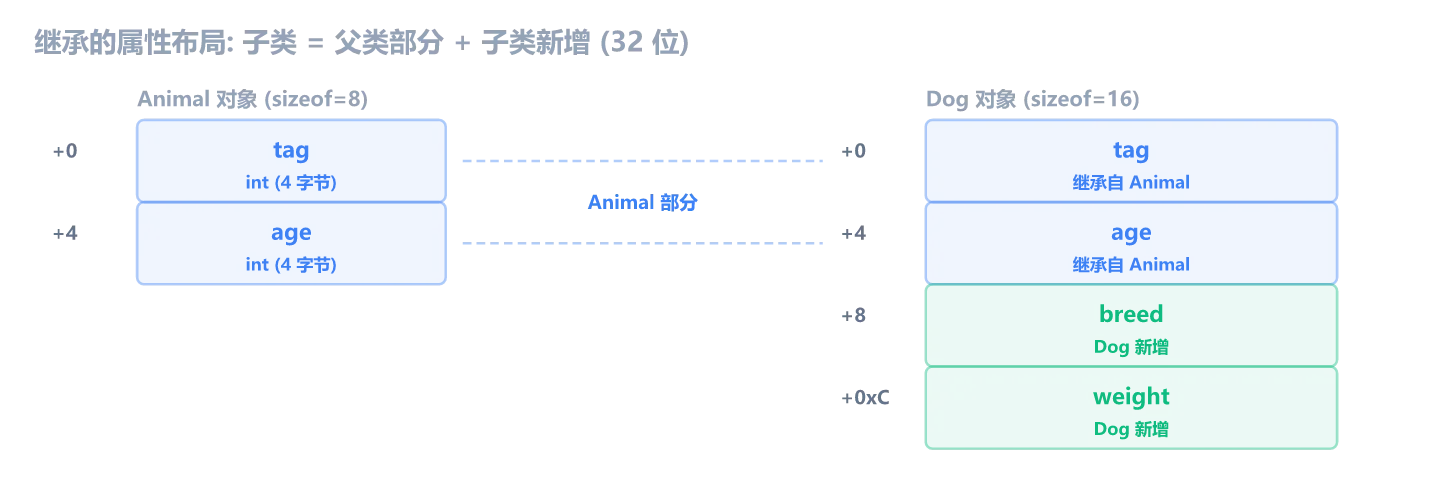
Dog 对象的前 8 字节就是完整的 Animal(tag + age),自己的成员从 +8 开始接在后面。sizeof(Dog) 是 16(Animal 的 8 + Dog 新增的 8)。编译器自动算好偏移,子类只是在父类布局末尾追加自己的成员。
这个布局规则的意义:Dog* 和 Animal* 指向同一个 Dog 对象时,地址相同。因为父类部分总在对象开头,Animal* 看到的就是前 8 字节,Dog* 看到完整的 16 字节,但两者指向同一个起始地址。这也是为什么单继承不需要 this 指针调整(下一章讲多继承时才需要)。
访问继承来的成员和访问自己的成员没有区别,都是 [ecx+offset]:
mov  eax, [ecx]          ; this->tag(继承的, 偏移 +0)
mov  eax, [ecx+4]        ; this->age(继承的, 偏移 +4)
mov  eax, [ecx+8]        ; this->breed(自己的, 偏移 +8)
mov eax, [ecx+0C] ; this->weight(自己的, 偏移 +0xC)如果父类有虚函数(有 vptr),vptr 占 +0,父类属性从 +4 开始,子类属性接在父类后面。例如 Animal 有 virtual void speak() 和 int tag,则 Animal 布局是 vptr(+0) + tag(+4),Dog : public Animal 的布局是 vptr(+0) + tag(+4) + breed(+8)。vptr 只有一个(子类覆盖父类的 vptr),不会因为继承多出一个。详见下一章虚函数表。
从汇编反推类结构
综合来看,从汇编反推 C++ 类结构的方法:
- 找 this 指针:调用前
lea ecx, [对象地址],ECX 就是 this - 找成员偏移:函数内部
[eax+offset]的 offset 对应成员位置 - 找成员类型:
dword ptr是 int/指针,byte ptr+movzx是 bool/char,movss是 float - 找参数个数:
ret N的 N 除以 4 = 栈上参数个数(this 不算) - 区分构造/析构/普通方法:构造函数全量初始化成员;析构函数在函数末尾调用做清理;普通方法读写部分成员
例如:
    mov  eax, dword ptr [ebp-8]     ; this
    mov  ecx, dword ptr [eax+4]     ; this->mp(偏移 +4)
    sub  ecx, dword ptr [ebp+8]     ; mp - amount
    mov  edx, dword ptr [ebp-8]     ; this
    mov  dword ptr [edx+4], ecx     ; this->mp = result
    ...
    ret  4
反推:方法有两个参数(this + 1 个 int),修改偏移 +4 的成员(可能是 mp),ret 4 说明 1 个栈参数。C 代码可能是 void use_mp(int amount) { mp -= amount; }。
逆向识别清单
| 特征 | 含义 |
|---|---|
lea ecx, [地址]; call func | thiscall 方法调用,ECX = this |
函数开头 push ecx; mov [ebp-8], ecx | 保存 this 到本地变量 |
mov eax, [ebp-8]; mov [eax+offset], val | 写成员(this->成员 = 值) |
mov eax, [ebp-8]; mov eax, [eax+offset] | 读成员(返回成员值) |
movzx eax, byte ptr [eax+offset] | 读 bool/char 成员 |
mov byte ptr [eax+offset], cl | 写 bool/char 成员 |
ret N(N > 0) | thiscall,N/4 个栈参数 |
ret(不带数字) | thiscall,0 个栈参数(只有 this) |
| 函数内对每个成员逐个赋常量 | 构造函数 |
函数末尾 lea ecx, [obj]; call func | 析构函数(对象生命周期结束) |
参数地址传入,函数内 mov [eax] 解引用 | 引用参数(和指针无法区分) |
C++ 类的汇编本质:方法是接受 this(ECX)的普通函数,成员访问是 [this+offset],对象布局是成员变量的平铺。和 C 结构体加函数指针没有本质区别。
以上讲的是 32 位 thiscall,this 走 ECX。64 位下没有单独的 thiscall 约定,this 直接当作第一个参数走 RCX(和 x64 fastcall 一致)。其余参数走 RDX/R8/R9/栈。逆向 64 位游戏时,看到 lea rcx, [obj]; call func,RCX 就是 this。
游戏引擎里的 Entity、Player、Weapon 都是 C++ 类。你在 x64dbg 里看到 lea ecx, [eax+70h]; call 00412345,就是在调用某个对象的虚方法(下一章讲虚函数表)。看到 [ecx+0A4h] 就知道在访问这个对象的偏移 0xA4 成员,可能是 hp 或坐标。用 ReClass.NET 还原类结构时,本质就是根据这些偏移重建成员布局。
练习
-
下面这段调用方代码调用了什么?this 在哪?参数在哪?
push 0x1E lea ecx, [ebp-24] call damage参考答案调用
damage(30)。lea ecx, [ebp-24]把 ECX 设为对象地址(this),push 0x1E压入参数 30(0x1E = 30)。这是 thiscall,this 走 ECX,amount 走栈。对应的 C 代码:p.damage(30)。 -
下面这段方法内部汇编,访问了哪些成员?偏移各是多少?
ret 4说明什么?mov eax, dword ptr [ebp-8] ; this mov ecx, dword ptr [eax+4] ; ??? sub ecx, dword ptr [ebp+8] mov edx, dword ptr [ebp-8] mov dword ptr [edx+4], ecx ; ??? ... ret 4参考答案访问偏移 +4 的成员(先读再写回,是读-改-写)。
[eax+4]是某个成员(可能是mp),先读出到 ECX,减去[ebp+8](第一个栈参数),再写回[edx+4]。ret 4说明 1 个栈参数(4 字节),加上 this 共 2 个参数。C 代码:void use_mp(int amount) { mp -= amount; }。 -
下面这段汇编是什么函数?怎么判断的?
mov dword ptr [ebp-8], ecx ... mov eax, dword ptr [ebp-8] mov dword ptr [eax], 0x64 mov eax, dword ptr [ebp-8] mov dword ptr [eax+4], 0x32 mov eax, dword ptr [ebp-8] mov dword ptr [eax+8], 0 mov eax, dword ptr [ebp-8] mov dword ptr [eax+0C], 0 ... ret参考答案这是构造函数。判断依据:对每个成员逐个赋常量(偏移 0 = 0x64=100,4 = 0x32=50,8 = 0,0xC = 0),是初始化操作。
ret不带数字,说明 0 个栈参数。C 代码:Player::Player() { hp = 100; mp = 50; x = 0; y = 0; }。 -
下面这段 main 末尾的汇编在做什么?
lea ecx, [ebp-24] call ??1Player@@QAE@XZ参考答案这是调用析构函数。
??1Player是 MSVC 的名称修饰(name mangling),??1前缀表示析构函数。lea ecx, [ebp-24]设置 this 为对象地址。在函数末尾调用析构,是局部对象生命周期的结束。对应的 C 代码:// 函数返回前,Player::~Player() 自动调用。 -
综合题:根据下面的调用方和方法内部汇编,还原类结构和方法签名。
调用方:
push 0x64
lea  ecx, [ebp-18]
call set_speed
方法内部:
set_speed: push ebp mov ebp, esp ... mov dword ptr [ebp-8], ecx ... mov eax, dword ptr [ebp-8] ; this mov ecx, dword ptr [ebp+8] ; s(第一栈参数) mov dword ptr [eax+8], ecx ; this->speed = s(偏移 +8) ... ret 4 ; 1 个栈参数参考答案调用方
push 0x64(100)压入参数,lea ecx, [ebp-18]设置 this,对象在[ebp-18]。方法内部从[ebp+8]读取参数到 ECX,再写入[eax+8](偏移 +8 的成员)。ret 4说明 1 个栈参数。类结构(部分):
class Entity {
    // 偏移 +0, +4 的成员未知
    int speed;   // 偏移 +8
    // ...
    void set_speed(int s) { speed = s; }
};